What Are Natural GLP-1 Alternatives for Perimenopause Fatigue?
Share
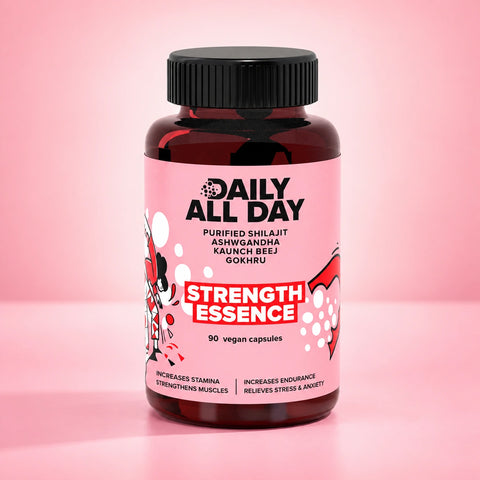
Quick Answer: Ashwagandha acts as a natural GLP-1 alternative for perimenopause fatigue by lowering cortisol, supporting mitochondrial signaling, and helping maintain hormonal balance without injections. Combined with shilajit and Kaunch Beej in Strength Essence- Energy and Stamina Booster, it targets the cellular energy gaps that perimenopause creates. Note: because ashwagandha can affect thyroid hormone levels, check with your provider first if you have a thyroid condition or take thyroid medication.
What Are Natural GLP-1 Alternatives for Perimenopause Fatigue?
GLP-1 medications get a lot of attention right now, and some of that attention has drifted toward perimenopause, where women are looking for anything that helps with low energy, weight creep, and metabolic slowdown. The honest answer is that GLP-1 drugs work through a very specific hormonal pathway, and no supplement replicates that exactly. But here's what most of the current conversation misses: perimenopause fatigue isn't purely a GLP-1 problem. It's a cortisol problem, a mitochondrial problem, and a dopamine problem, all at once. Addressing those three roots with a natural GLP-1 alternative for perimenopause fatigue is not only possible, it's often more practical for women who aren't candidates for prescription drugs or simply prefer to start elsewhere.
This post covers the specific mechanisms, the ingredients with real clinical support, and what to realistically expect week by week.
Why Perimenopause Fatigue Has Three Distinct Drivers (Most Articles Name One)
Most coverage of natural GLP-1 alternatives for perimenopause fatigue focuses on metabolism and weight. That's a real concern, but it skips two other drivers that matter just as much for the energy piece.
Driver one: cortisol dysregulation. As estrogen fluctuates, the HPA axis (the adrenal stress system) becomes less stable. Cortisol that was once well-regulated starts spiking at odd hours, especially at 2–4 a.m., which fragments sleep and leaves women wired but exhausted by mid-morning. This is not ordinary tiredness. No amount of sleep fixes it until cortisol rhythms normalize.
Driver two: mitochondrial inefficiency. Estrogen is, among other things, a mitochondrial protectant. It supports the efficiency of the electron transport chain, the process by which your cells convert food into usable ATP energy. When estrogen drops, ATP production becomes less efficient. Women feel this as a physical heaviness, a kind of effort tax on everything they do.
Driver three: low dopamine tone. The unmotivated, flat, "what's the point" fatigue that many perimenopausal women describe is neurochemical. Dopamine is not just a mood molecule; it drives initiation, motivation, and the subjective sense of having energy. GLP-1 receptors in the brain actually interact with dopamine pathways, which is partly why GLP-1 drugs affect appetite and mood. This is a gap that almost no article on natural GLP-1 alternatives for perimenopause fatigue addresses. It's also one of the most addressable with specific botanicals.
How Ashwagandha Works as a Natural GLP-1 Alternative for Perimenopause Fatigue
Ashwagandha (Withania somnifera) doesn't mimic GLP-1 directly. What it does is address cortisol driver one in a measurable, clinically documented way. A 2019 randomized, double-blind, placebo-controlled trial of 60 adults published in Medicine found that 240 mg of standardized ashwagandha root extract daily produced significant reductions in serum cortisol, self-reported stress, and sleep disturbance scores compared to placebo over eight weeks.[1] For perimenopausal women whose adrenal stress system is already strained, that cortisol reduction translates directly into improved morning energy and fewer nighttime wake-ups.
There's also a thyroid-adjacent note worth flagging, not as a benefit but as a caution: some research suggests ashwagandha can influence thyroid hormone levels. Because thyroid function often shifts during perimenopause, women with a diagnosed thyroid condition or who take thyroid medication should talk to their provider before adding ashwagandha, rather than starting on their own.
Shilajit and Kaunch Beej: The Mitochondrial and Dopamine Pieces
Shilajit's active compound, fulvic acid, functions as a cellular transport molecule. It helps shuttle CoQ10 and other cofactors into mitochondria, directly supporting ATP synthesis. A 2012 study in the Journal of Ethnopharmacology demonstrated that processed shilajit preserved mitochondrial function under conditions of chronic stress and aging.[2] For women whose mitochondrial efficiency has dropped as estrogen declines, this is a meaningful compensatory mechanism.
Kaunch Beej (Mucuna pruriens) addresses driver three. It's a natural source of L-DOPA, the direct precursor to dopamine. When dopamine tone is low, the motivation and initiation that feel like "energy" simply don't show up, regardless of how much sleep or nutrition a woman is getting. Restoring dopamine tone through a well-sourced L-DOPA botanical is a different mechanism from GLP-1, but it arrives at a very similar effect on motivation, appetite regulation, and mood-adjacent energy.
The combination of all three (ashwagandha, shilajit, and Kaunch Beej) in Strength Essence- Energy and Stamina Booster is specifically designed to address all three fatigue drivers together, rather than asking women to manage three separate supplements.
For a broader look at how Ayurvedic adaptogens compare to pharmaceutical options for metabolism, see this overview of Natural Ozempic Alternatives Supplements That Support Weight Loss.
Who Is This For (and Who Should Talk to a Doctor First)
Adaptogenic supplements like Strength Essence are a reasonable starting point for women in early-to-mid perimenopause who have mild-to-moderate fatigue, whose primary symptoms are low energy, poor sleep, and motivational flatness, and who prefer to begin without prescription intervention. They're also a practical complement for women already on HRT who have residual fatigue that hormones alone haven't resolved.
Who should consult a provider first: women with diagnosed thyroid conditions or on thyroid medication (ashwagandha may influence thyroid hormone levels), women on immunosuppressants or sedatives, women who are pregnant or nursing, and women whose fatigue is severe, sudden, or accompanied by cardiac symptoms. This isn't a cautionary disclaimer for its own sake. Adaptogens interact with real physiological systems, and that's precisely why a doctor's input matters before starting.
Inflammation also plays a meaningful role in perimenopausal fatigue. A 2012 meta-analysis in PLOS ONE covering multiple randomized trials found that omega-3 supplementation significantly reduced circulating inflammatory markers, which are known energy thieves during hormonal transitions.[3] Pairing adaptogens with adequate omega-3 intake addresses the inflammatory layer that adaptogens don't directly target.
If cortisol and stress are your primary concerns alongside fatigue, the post on Green Tea for Cortisol Reduction: Remote Worker Stress Relief covers additional cortisol-lowering strategies that stack well with ashwagandha.
30 / 60 / 90 Day Timeline: What to Realistically Expect
By day 30: Most women notice improved sleep continuity and a mild reduction in that mid-morning cortisol slump. Energy isn't dramatically transformed yet, but the jagged, wired-tired feeling tends to soften. Motivation may feel marginally more accessible. This is the Kaunch Beej and cortisol work beginning to accumulate.
By day 60: The mitochondrial support from shilajit tends to become more perceptible around this point. Physical tasks that felt disproportionately effortful start to require less recovery. Women often report that they're reaching for afternoon coffee less automatically. Sleep quality improvements, if they began at day 30, tend to consolidate.
By day 90: This is when adaptogenic effects are most established. Cortisol rhythm normalization is more stable, energy feels more predictable across the day, and the motivational flatness that characterized early perimenopause is noticeably reduced for many women. Results vary, and women who pair the supplement with protein-rich meals, consistent sleep timing, and reduced afternoon caffeine report faster and more pronounced outcomes.
Adaptogens are cumulative, not acute. The day-90 version of yourself is the intended target. Consistency matters far more than timing within the day, though taking Strength Essence with food tends to improve tolerability.
Frequently Asked Questions
Are natural GLP-1 alternatives for perimenopause fatigue actually effective, or is this just marketing?
The honest answer is: it depends on which symptoms you're prioritizing. If the primary goal is rapid weight loss through appetite suppression, no natural supplement matches a pharmaceutical GLP-1 agonist. But if the goal is restoring energy, improving sleep quality, and stabilizing mood during perimenopause, adaptogens like ashwagandha have genuine clinical support. A 2019 trial of 60 adults showed significant cortisol reduction and energy improvements with standardized ashwagandha extract over eight weeks. That's a real mechanism, not a positioning claim.
Does ashwagandha affect hormones directly, or just cortisol?
Both, to some extent. Ashwagandha's most documented effect is on cortisol via HPA axis modulation. But because cortisol and sex hormones share precursor pathways, lowering chronic cortisol can free up adrenal capacity for other hormone production. There is also a small body of evidence suggesting ashwagandha can influence thyroid hormone levels, which is why anyone with a diagnosed thyroid condition or on thyroid medication should check with their provider before use. It does not raise estrogen directly.
How is the fatigue from perimenopause different from regular burnout fatigue?
Perimenopausal fatigue is characterized by unrefreshing sleep, physical heaviness that appears disproportionate to activity level, cognitive fog, and a flat or unmotivated quality that isn't resolved by rest or a good night's sleep. Burnout fatigue tends to improve with rest and disengagement. Perimenopausal fatigue persists through weekends and vacations because it's driven by hormonal and mitochondrial changes, not just stress accumulation.
Can I take Strength Essence alongside HRT?
Generally yes, but with one note of caution: if your HRT includes thyroid medication, consult your provider before adding ashwagandha, since both affect thyroid hormone levels. For women on estrogen or progesterone therapy alone, there are no widely documented interactions with ashwagandha, shilajit, or Kaunch Beej. Many women use adaptogenic formulas alongside HRT specifically for residual fatigue and energy that hormonal therapy alone doesn't resolve.
What dosage of ashwagandha is clinically supported for fatigue?
The 2019 trial that demonstrated significant cortisol reduction used 240 mg of standardized ashwagandha root extract daily. Other well-designed studies have used 300–600 mg of KSM-66 extract. Because ashwagandha can affect thyroid hormone levels, talk to your healthcare provider before starting any dose, especially if you have a thyroid condition, take thyroid medication, are pregnant or nursing, or are on other prescriptions. The key variable for choosing a product is standardization: look for supplements that specify withanolide content (typically 5% or higher) rather than just listing "ashwagandha" as a raw herb.
How does Kaunch Beej support energy differently from ashwagandha?
Ashwagandha primarily addresses cortisol and adrenal stress. Kaunch Beej (Mucuna pruriens) provides natural L-DOPA, a direct dopamine precursor. Dopamine is central to motivation, initiation, and the subjective sense of having energy and drive. When dopamine tone is low, women feel a flat, unmotivated fatigue that persists even after physical rest. These two herbs work on different but complementary systems, which is why combining them tends to be more effective than either alone for perimenopausal fatigue.
If you're ready to work on all three drivers of perimenopause fatigue at once, rather than cycling through single-ingredient supplements, the formula is worth a closer look.
See the full Strength Essence- Energy and Stamina Booster formula