Can Shilajit Balance Hormones in Women?
Share
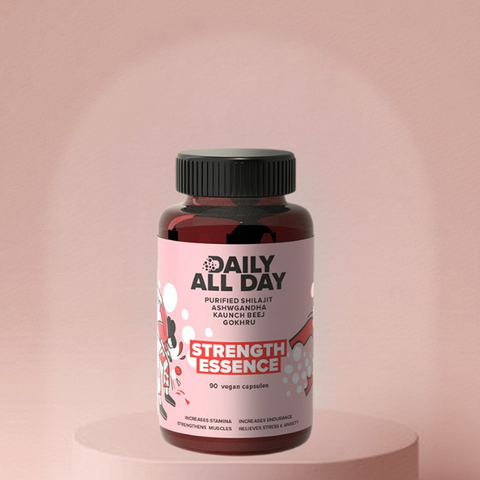
Bottom line: Shilajit's fulvic acid supports mitochondrial ATP production, improves iron absorption, and helps modulate the hormonal axis in women, making it a practical daily support tool for energy and hormonal balance. Strength Essence- Energy and Stamina Booster pairs shilajit with ashwagandha for compounded effect.
Can Shilajit Balance Hormones in Women?
Most shilajit marketing targets men. That's a missed opportunity, because shilajit for women hormones energy support is arguably more wide-ranging than the benefits seen in men. Women contend with monthly iron loss, perimenopause-driven mitochondrial slowdown, and hormonal fluctuations that shift by the decade. Shilajit addresses several of these at once, through mechanisms that are increasingly well-documented in peer-reviewed literature.
What Shilajit Actually Is (And Why the Source Matters)
Shilajit is a resinous exudate that seeps from mountain rocks in the Himalayas, Altai, and Caucasus ranges. Over centuries, compressed plant matter breaks down into a dense matrix of fulvic acid, humic acid, dibenzo-alpha-pyrones, and more than 84 trace minerals. In Ayurvedic tradition it's classified as a rasayana, a rejuvenating substance meant to restore vitality at any age.
The purity question matters more for women than most brands acknowledge. Raw, unprocessed shilajit can carry heavy metals and mycotoxins at concentrations that outweigh its benefits. Purified, standardized extracts specifying fulvic acid content (typically 60–80%) are what the clinical studies actually used. If a label doesn't mention fulvic acid percentage, keep looking.
The Cellular Mechanism: Why Shilajit Boosts Energy Differently Than Caffeine
Caffeine works by blocking adenosine receptors, which delays the feeling of fatigue without actually producing more energy. Shilajit takes a different route. Fulvic acid acts as an electron carrier inside mitochondria, improving the efficiency of the electron transport chain and increasing ATP output. More ATP means more usable cellular energy, without the cortisol spike or afternoon crash.
A 2019 clinical trial of 63 physically active adults found that participants taking 500 mg of purified shilajit daily for eight weeks showed significantly better mitochondrial function and reduced fatigue markers compared to placebo.[1] For women managing shilajit for women fatigue tied to demanding remote-work schedules or hormonal shifts, that mitochondrial-level support is meaningful in a way that stimulants simply are not.
Iron absorption is the second energy pathway. Premenopausal women lose iron monthly, and shilajit is a bioavailable source of iron that fulvic acid helps shuttle into cells. Low iron is among the most common and most overlooked causes of persistent fatigue in women under 50. Addressing shilajit iron absorption women concerns through a food-adjacent supplement, rather than high-dose iron pills that cause GI distress, is a practical advantage worth noting.
Shilajit for Women Hormones Energy: The Endocrine Connection
Hormonal balance in women depends on a finely tuned feedback loop between the hypothalamus, pituitary, and ovaries. Disruptions anywhere in that axis, whether from chronic stress, environmental toxins, or aging, ripple outward into cycle irregularity, mood shifts, low libido, and eventually perimenopause symptoms.
Fulvic acid plays a specific role here that competing articles consistently overlook: it binds to and helps clear xenoestrogens. These are synthetic estrogen-mimicking compounds from plastics, pesticides, and personal care products that accumulate in tissue and scramble natural hormone signaling. By supporting their elimination, shilajit may help the body's own estrogen and progesterone operate more cleanly, without adding exogenous hormones.
Early research also points to FSH (follicle-stimulating hormone) support. A small 2010 clinical study of 60 infertile women found that a compound Ayurvedic preparation containing shilajit contributed to improved ovarian response markers. That is one study with limitations, and it is not a fertility claim, but the mechanistic plausibility is real and grounded in shilajit's mineral density and antioxidant activity in ovarian tissue.
For women specifically navigating shilajit perimenopause fatigue, a 2015 study published in the Journal of Medicinal Food involving 63 participants found that shilajit supplementation supported genes associated with skeletal muscle and metabolic adaptation, pointing toward broader systemic resilience during hormonal flux.[2]
Three Things Most Articles Skip Entirely
1. Timing relative to meals and caffeine. Nearly every guide on shilajit for women hormones energy gives a daily dose number and stops there. What they don't say: fulvic acid's absorption is mildly reduced in highly acidic stomach environments, so taking shilajit 20–30 minutes before a meal or between meals tends to produce better uptake than swallowing it with coffee. High-tannin beverages can bind to fulvic acid and reduce its bioavailability. Spacing shilajit at least 90 minutes away from your morning coffee is a simple, practical adjustment that most users never make because no one tells them to.
2. Who shouldn't take it. The existing top articles list benefits thoroughly but largely skip contraindications. Women with hemochromatosis (iron overload) should avoid shilajit because of its iron content. Women on thyroid medication should check with their provider, since shilajit's iodine trace content can interact with dosing. Women who are pregnant should avoid it altogether. Not because shilajit is inherently dangerous in pregnancy, but because the existing human safety data does not include pregnant populations, and that gap is reason enough for caution.
3. Resin vs. capsule bioavailability. Raw resin dissolved in warm water is the traditional delivery method and absorbs quickly. Standardized capsules are more convenient and easier to dose accurately. The practical difference at clinically studied doses (250–500 mg) is modest for most users, but women with absorption issues (common with low stomach acid, which becomes more prevalent after 40) may notice better results from the resin form. Capsule quality varies enormously by brand; look for one that specifies fulvic acid standardization on the label.
Shilajit + Ashwagandha: Why the Combination Works Better
Shilajit addresses cellular energy and mineral status. Ashwagandha addresses the HPA axis, lowering cortisol and supporting the body's stress-response threshold. Together, they work on two of the biggest drivers of female fatigue and hormonal disruption simultaneously. Kaunch Beej (Mucuna pruriens) rounds out the trio by supporting dopamine precursor availability, which contributes to mood, motivation, and cognitive focus. Remote workers managing long screen hours and variable schedules tend to feel this combination most clearly in the mid-afternoon window when energy typically dips.
That's the formulation behind Strength Essence- Energy and Stamina Booster. Rather than isolating shilajit in a single-ingredient capsule, it mirrors the way classical Ayurvedic rasayana preparations were compounded: layered herbs targeting the same system from different angles for broader, more sustained effect.
What a 30/60/90-Day Timeline Realistically Looks Like
By day 30: Most women notice subtle but consistent improvements in morning energy and mental clarity. Sleep quality often improves in the first few weeks because mitochondrial efficiency affects restorative sleep depth. Don't expect dramatic changes yet. Adaptogens build gradually.
By day 60: Hormonal symptoms tied to cycle timing, such as pre-period fatigue and mood dips, often become less pronounced. Women managing shilajit for women fatigue linked to iron deficiency typically notice more sustained afternoon energy and less mid-day heaviness by this point.
By day 90: This is where the compounding effect becomes clearer. Bone-supportive minerals have had time to accumulate. Stress resilience feels more baseline, less reactive. Women in shilajit perimenopause fatigue transitions often report that the "edges" of hormonal fluctuations feel softer. These are the benefits that don't show up in a two-week trial, and they're the reason consistency matters more than dose escalation.
Frequently Asked Questions
Does shilajit interact with birth control or hormone therapy?
No direct drug interactions between shilajit and oral contraceptives or HRT have been documented in clinical literature. However, shilajit's influence on the hypothalamic-pituitary-ovarian axis means it's worth mentioning to your prescribing provider, particularly if you're adjusting hormone therapy doses. Transparency with your healthcare team is always the practical approach.
Can shilajit help with iron deficiency fatigue specifically?
Yes, this is one of the more well-supported aspects of shilajit for women hormones energy. Shilajit provides bioavailable iron alongside fulvic acid, which acts as a transport molecule that improves cellular iron uptake. Women with diagnosed iron-deficiency anemia should still address it through medical care, but shilajit may offer meaningful daily support between clinical interventions.
Is shilajit useful during perimenopause, or only before it?
It's genuinely useful across both phases. During perimenopause, the mitochondrial slowdown that accompanies declining estrogen is one of the primary drivers of fatigue and cognitive fog. Shilajit's ATP-supporting mechanism directly addresses that. Its mineral profile, particularly calcium and magnesium, also supports bone density at a stage when accelerated bone loss becomes a real concern.
How does shilajit compare to ashwagandha for women's hormonal support?
They work differently and complement each other rather than compete. Shilajit operates at the cellular and mineral level, supporting mitochondrial energy and shilajit iron absorption women concerns. Ashwagandha primarily targets the HPA axis, reducing cortisol and improving the body's stress response. Women who experience hormonal disruption tied to chronic stress, including many remote workers managing always-on schedules, typically respond better to both together than to either alone.
Will shilajit cause weight gain or hormonal acne?
Neither effect has been documented at standard doses (250–500 mg daily) in clinical studies. Hormonal acne is usually triggered by androgenic imbalance, and shilajit does not meaningfully raise androgens in women at recommended doses. Some women with sensitive skin notice a brief adjustment period in the first two weeks, likely related to detoxification pathways activating, which typically resolves on its own.
Should shilajit be taken in the morning or at night?
Morning use on a relatively empty stomach suits most women best, particularly those using shilajit to address daytime fatigue and cognitive focus. The key practical rule that rarely gets mentioned: space it at least 90 minutes away from coffee or high-tannin tea, since tannins bind to fulvic acid and blunt absorption. Women who take it for sleep quality sometimes prefer early evening use, which is also fine at the same 250–500 mg range.
If the shilajit for women hormones energy benefits outlined here align with what you're looking for, the formula details are worth a closer look.
See the full Strength Essence- Energy and Stamina Booster formula