What Are Ashwagandha Side Effects for Women?
Share
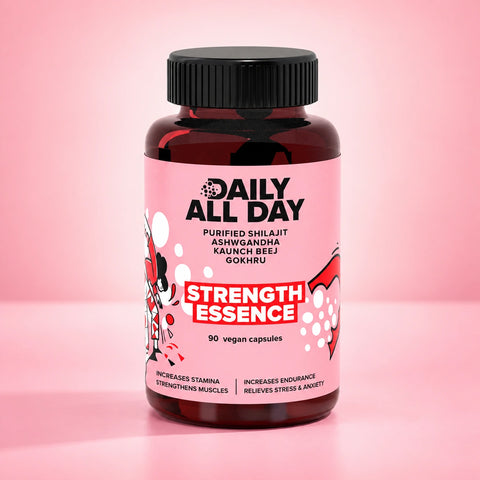
Quick Answer: Ashwagandha (Withania somnifera) works by lowering cortisol through the HPA axis, but ashwagandha side effects for women can include digestive upset, drowsiness, and hormonal shifts that matter at different life stages. Most are dose-dependent and avoidable. Strength Essence- Energy and Stamina Booster uses a standardized root extract formulated for daily use.
What Are Ashwagandha Side Effects for Women?
Most articles on ashwagandha list nausea and drowsiness, then stop. That's not enough — especially for women, where the hormonal picture is considerably more complicated. Ashwagandha side effects for women interact with thyroid function, the menstrual cycle, perimenopause, and even autoimmune status in ways that deserve a real conversation. Here's what the clinical record actually shows.
How Ashwagandha Works in the Female Body
Withania somnifera is classified as a Rasayana in Ayurvedic medicine — an herb used to restore vitality and resilience. The active compounds, called withanolides, act primarily on the hypothalamic-pituitary-adrenal (HPA) axis, blunting the cortisol response to stress. A 2012 randomized controlled trial of 64 adults found that 300 mg of a KSM-66 root extract twice daily reduced serum cortisol by 27.9% compared to placebo over 60 days.[1]
For women, that cortisol drop matters in layers. Chronically elevated cortisol competes with progesterone for receptor binding, suppresses thyroid conversion of T4 to active T3, and disrupts the LH surge needed for ovulation. Bring cortisol down and you may see a cascade of downstream hormonal improvements. But the same mechanism also means ashwagandha is genuinely bioactive — and that's why a subset of women experience effects they weren't expecting.
Common Ashwagandha Side Effects for Women
The most frequently reported issues are digestive: nausea, loose stools, and mild stomach upset. These almost always occur when ashwagandha is taken on an empty stomach. Taking it with food , or with warm milk, the traditional Ayurvedic method , resolves this for most people within a few days.
Drowsiness is the second most common complaint. Ashwagandha has genuine GABAergic activity, meaning it calms neural excitability. That's useful at night for sleep, but a morning dose can leave some women feeling foggy. The fix is simple: shift your dose to the evening if sedation is an issue.
Headache shows up in a small percentage of new users, typically in the first week or two. It seems to be a transient adjustment response rather than a persistent problem. If it doesn't resolve by week three, that's a sign the dose may need to come down.
The Hormonal Effects: Nuanced, Not Scary
This is the section most general articles skip, and it's where ashwagandha and hormones women need to understand most clearly.
Thyroid function. A 2018 randomized trial of 50 adults with subclinical hypothyroidism found that 600 mg of ashwagandha root extract daily for 8 weeks significantly increased serum T3 and T4 levels compared to placebo.[2] For women with undiagnosed sluggish thyroid, this could be a welcome effect. For women already on levothyroxine or other thyroid medication, it could push levels too high. If you're on thyroid medication, get levels checked before starting and again at 8 weeks.
Reproductive hormones. Ashwagandha may modestly raise DHEA-S and, in some studies, testosterone. In women who want better libido and energy, this is a benefit. In women with androgen-dominant PCOS, it could theoretically worsen symptoms like acne or irregular cycles. The clinical data here is still limited, so women with a confirmed PCOS diagnosis should loop in their endocrinologist before starting.
Menstrual cycle changes. Because ashwagandha cortisol women's research consistently shows lowered cortisol, women whose cycles were stress-disrupted sometimes report more regularity after a few weeks. Others notice a temporary shift in cycle length as hormones recalibrate. Both responses are plausible. Significant or prolonged irregularity warrants pausing the supplement and consulting a gynecologist.
Who Should Avoid Ashwagandha or Proceed Carefully
Three groups that most articles mention only in passing:
Pregnant women, all trimesters. Classical Ayurvedic texts flag ashwagandha as uterine-stimulating, and modern safety data in human pregnancy is essentially absent. The caution applies from conception onward, not just the first trimester. If you discover you're pregnant after already taking it, stop, and let your OB know at your next visit , single-supplement exposure at typical doses is unlikely to be harmful, but continuing is not advisable.
Women with autoimmune conditions. Ashwagandha is an immune modulator. For conditions like Hashimoto's, lupus, or rheumatoid arthritis, this could amplify immune activity and potentially worsen flares. The thyroid connection is especially relevant: Hashimoto's is the most common autoimmune condition in American women, and many don't know they have it. If you have elevated TPO antibodies, get a proper diagnosis before using ashwagandha for thyroid support.
Women on sedatives, benzodiazepines, or immunosuppressants. Ashwagandha may potentiate the sedative effects of these medications and may interfere with immunosuppressant efficacy. There have also been rare case reports of liver enzyme elevation with very high doses or adulterated products. Sticking to a standardized extract from a reputable source, at recommended doses, keeps this risk low.
Is Ashwagandha Safe for Women Daily? Dosing and Timing
The answer for most healthy, non-pregnant women is yes , with a few ground rules. Standard evidence-backed doses run 300–600 mg of a root extract standardized to 5% withanolides (KSM-66 or Sensoril are the most studied forms). Start at 300 mg with dinner for the first two weeks. If you tolerate it well and want more pronounced effects on energy or cortisol, move to 600 mg. Beyond 600 mg daily, you're in the range where GI side effects and thyroid-stimulating effects become more likely.
Most practitioners recommend cycling: 8–12 weeks on, then a 3–4 week break. Adaptogens tend to work best when the body hasn't fully habituated to them.
What 30, 60, and 90 Days Actually Look Like
By day 30: Digestive adjustment (if any) has resolved. Most women notice improved sleep quality and a quieter stress response , less reactive, not sedated. Some notice slightly more stable energy through the afternoon.
By day 60: This is where cortisol reduction becomes more measurable. The 2012 trial of 64 adults cited above saw its most significant cortisol drops at the 60-day mark. Women dealing with stress-related cycle disruption may start noticing more consistency here.
By day 90: Libido, fatigue resilience, and mood stability are the benefits most commonly reported in this window , particularly by women in perimenopause or those with high baseline stress. A 2021 systematic review covering 5 trials and 400 participants confirmed that ashwagandha supplementation significantly reduced stress and anxiety with a favorable safety profile across study durations of 8–12 weeks.[3]
If you want to pair ashwagandha with complementary adaptogens for a more complete energy and stamina approach, Strength Essence- Energy and Stamina Booster combines a standardized ashwagandha root extract with Shilajit and Kaunch Beej , a formulation grounded in Ayurvedic tradition and designed for daily use. For more on how Shilajit specifically supports female hormone balance, see Can Shilajit Balance Hormones in Women?
Frequently Asked Questions
Can ashwagandha affect my menstrual cycle?
Yes, indirectly. Ashwagandha lowers cortisol, which can release the suppression stress places on the LH surge and progesterone production. Women whose cycles were already stress-disrupted sometimes see them become more regular within 4–8 weeks. However, a temporary shift in cycle timing is also possible during the initial hormonal recalibration period. Significant or lasting irregularity is a reason to pause and consult your gynecologist.
Is ashwagandha safe during perimenopause?
Small clinical studies suggest ashwagandha may support hormonal balance, improve sleep, and reduce the intensity of stress-related symptoms during perimenopause. It is generally considered safe for perimenopausal women who are not on hormone replacement therapy. If you are on HRT, discuss potential interactions with your prescribing physician, particularly around thyroid and estrogen-adjacent pathways, before adding ashwagandha.
Why does ashwagandha make me feel drowsy during the day?
Ashwagandha has documented GABAergic activity, meaning it calms neural excitability in a way that is similar in mechanism (though much milder in degree) to anti-anxiety medications. If you're taking it in the morning, try shifting your dose to the evening. For most women, evening dosing converts daytime drowsiness into improved sleep quality , which is actually one of the herb's well-supported benefits.
Can ashwagandha worsen thyroid problems in women?
Possibly, in specific scenarios. A 2018 trial of 50 adults showed ashwagandha raised T3 and T4 in people with subclinical hypothyroidism , a benefit for some, but a concern for women already on thyroid medication who could end up with elevated levels. Women with Hashimoto's thyroiditis should also be cautious, since ashwagandha's immune-modulating properties may interact with the autoimmune component of that condition. Always check thyroid levels before starting and at 8 weeks if you have any thyroid history.
What form of ashwagandha is best for women , root extract, powder, or gummies?
Standardized root extracts (KSM-66 or Sensoril, both tested in human clinical trials) offer the most reliable withanolide content and the best clinical backing. Loose root powder is traditional and effective but harder to dose consistently. Gummies are the least reliable option , they frequently contain lower active doses and added sugars that offset some wellness goals. For daily use, a capsule with a verified standardized extract is the most practical and evidence-backed choice.
Is it safe to take ashwagandha every day long-term?
For healthy, non-pregnant women without autoimmune conditions or thyroid medication, daily use at 300–600 mg of a standardized extract appears safe based on trials lasting up to 12 weeks. Most practitioners recommend cycling , roughly 8–12 weeks on, followed by a 3–4 week break , both to prevent tolerance and to give your body a reset. Rare cases of liver enzyme elevation have been linked to very high doses or low-quality products, so sourcing from a reputable brand matters.
If you're ready to see how a well-formulated, standardized ashwagandha blend fits into a real daily routine, here's where to start:
See the full Strength Essence- Energy and Stamina Booster formula