Can Sea Buckthorn Juice Give You Glowing Skin?
Share
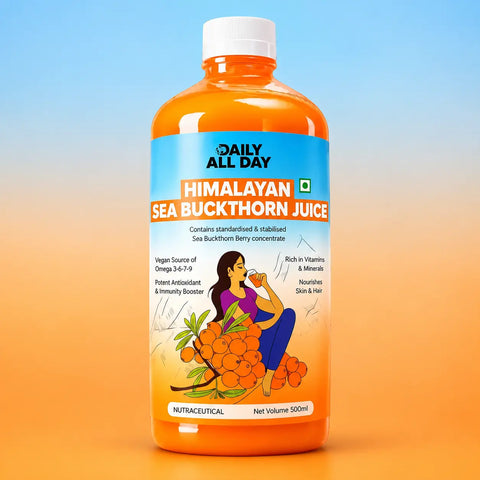
Quick Answer: Sea buckthorn juice delivers omega-7 (palmitoleic acid), vitamin C, and beta-carotene that work together to rebuild your skin barrier, support collagen production, and help support skin's natural radiance from within. Daily All Day's Sea Buckthorn Juice- Glowing Skin & Omega 7 brings this Himalayan berry to sea buckthorn juice in usa shoppers in a clean, concentrated daily format.
Can Sea Buckthorn Juice Give You Glowing Skin?
There's a quiet paradox in American skincare: people spend hundreds on serums applied to the outside of their face, yet chronically under-nourish the skin cells underneath. Sea buckthorn juice flips that logic. Available as sea buckthorn juice in usa wellness routines for the past decade, this tart Himalayan berry packs a nutritional profile unlike almost anything else in the plant kingdom, and its benefits show up on your face in ways a topical product simply cannot replicate.
What Makes Sea Buckthorn Juice Different From Other Skin Supplements?
Most skin-focused supplements lean on a single angle: collagen peptides for firmness, vitamin C for brightening, biotin for barrier support. Sea buckthorn covers all three simultaneously, plus a compound most Americans have never even heard of: omega-7 fatty acids.
Omega-7, technically palmitoleic acid, is a monounsaturated fat found naturally in your skin's own lipid layer. It keeps your skin barrier intact, helps cells hold onto moisture, and signals skin tissue to regenerate. The problem is that dietary omega-7 is genuinely rare. Macadamia nuts contain modest amounts, and cold-water fish have some, but sea buckthorn berries are among the most concentrated plant sources on Earth. When you drink the juice daily, those fatty acids travel through your gut into your bloodstream and directly into skin tissue, restoring what years of stress, UV exposure, and processed food have quietly depleted.
Sea buckthorn also contains vitamin C at concentrations roughly 10 to 12 times higher than oranges, alongside vitamin E tocotrienols, beta-carotene, lycopene, quercetin, and over 190 other bioactive compounds. It's not a supplement built around one mechanism. It's a whole-food matrix that addresses skin hydration, collagen synthesis, and inflammation at the same time.
The Science: What Clinical Research Actually Shows
A 2013 randomized trial of 98 women published in the Journal of Nutritional Biochemistry found that oral sea buckthorn oil supplementation significantly improved skin elasticity and moisture retention compared to a control group after 90 days of use.[1] The mechanism wasn't mysterious: the omega-7 content rebuilt participants' skin lipid barriers from within, producing measurable changes in transepidermal water loss — the clinical marker for how well your skin holds moisture.
A separate 2010 study of 39 adults, published in Skin Pharmacology and Physiology, confirmed that antioxidant-rich botanical compounds reduce measurable markers of photoaging and support the skin's own repair pathways.[2] The carotenoid and flavonoid load in sea buckthorn maps directly onto that mechanism, which is why regular users often notice fading of sun-related uneven tone alongside improved texture.
These aren't vague associations. The pathway is specific: omega-7 rebuilds the lipid bilayer, vitamin C feeds the enzymatic reactions that produce collagen, and the antioxidant pool neutralizes the free radicals that break both of them down. All three processes happen simultaneously when you consume the whole-berry juice.
What Nobody Tells You: Three Things Most Sea Buckthorn Pages Skip
How much omega-7 you actually need, and when to take it. Most product pages mention omega-7 without ever stating a useful context. Research on palmitoleic acid and skin barrier function generally points to consistent daily intake over a sustained period, not a one-off dose. Taking sea buckthorn juice with a meal that contains some fat (even just avocado toast or eggs) meaningfully improves absorption because palmitoleic acid is fat-soluble. Taking it on an empty stomach with black coffee, which many people do, reduces how much you actually absorb. Morning with breakfast, or alongside lunch, is more practical than a fasted shot.
Who shouldn't take sea buckthorn juice. Because sea buckthorn has mild blood-thinning properties related to its flavonoid and omega fatty acid content, people on anticoagulant medications like warfarin should check with their doctor before adding it regularly. People with known hypersensitivity to plants in the Elaeagnaceae family should also exercise caution. Pregnant women are commonly advised to consult a healthcare provider before starting any new supplement, and sea buckthorn is no exception: the high vitamin A activity from beta-carotene means it's worth a conversation with your OB even though food-form carotenoids carry far lower risk than preformed retinol supplements.
Juice versus capsule: why form matters for skin outcomes. Capsules isolate specific fractions, typically the oil, which is rich in omega-7 but lower in water-soluble vitamin C and flavonoids. Juice delivers the whole-berry matrix, including water-soluble nutrients that capsules often exclude. If your primary goal is skin hydration and barrier repair, the oil fraction in capsules is relevant. But for the full collagen-supporting, antioxidant-rich picture, whole-berry juice is the more complete format. That's a real distinction, not marketing language. For anyone serious about the omega-7 sea buckthorn skin benefits and the antioxidant picture together, juice is worth the consideration. For more on how sea buckthorn supports skin from a remote-worker perspective, this Sea Buckthorn Juice for Office Skin: Remote Worker Guide goes deeper on the daily routine angle.
What 30, 60, and 90 Days Actually Look Like
Individual results vary based on diet, skin type, and consistency of use — the timeline below reflects general patterns some users report and clinical trial averages, not a guaranteed outcome for every user.
By day 30: Most people notice their skin feels less tight after washing and looks less dull by mid-afternoon. These early changes reflect improved skin barrier hydration, not a dramatic transformation. If you have dry or dehydrated skin, this is usually the first thing you notice: a baseline softness that wasn't there before.
By day 60: Skin tone tends to look more even. Some people report their skin tone looking more even over time, which aligns with beta-carotene supporting healthy cell turnover. Fine lines around the eyes and mouth may appear slightly less pronounced, though this varies by age and baseline collagen levels.
By day 90: This is where the clinical research shows the most consistent results. The 2013 trial of 98 women cited above found statistically significant elasticity and moisture improvements at the 90-day mark specifically. Skin feels more resilient, less reactive to environmental changes, and more consistently radiant. This is also the window where people who deal with occasional redness or sensitivity tend to report their skin looking calmer and more balanced.
Consistency matters more than quantity. A daily small serving beats an occasional larger one, because skin cells turn over on a roughly 28-day cycle, and you need sustained nutrient availability across multiple cycles to see structural change.
How Daily All Day's Formula Fits In
Finding quality sea buckthorn juice in usa retail has historically been inconsistent. Many products are diluted, heat-processed (which degrades vitamin C significantly), or blended with cheap filler juices that dilute the active content. Daily All Day's Sea Buckthorn Juice- Glowing Skin & Omega 7 is formulated from Himalayan sea buckthorn berries and is designed to preserve the full-spectrum nutrient profile, including the water-soluble and fat-soluble fractions together. It integrates cleanly into a morning routine alongside breakfast, without complicated protocols.
If you're also curious about sea buckthorn's other everyday wellness uses, this broader overview of Sea Buckthorn Juice Benefits Skin & Immunity Naturally is worth reading alongside this one.
Frequently Asked Questions
Is sea buckthorn juice widely available in the USA, or do I need to import it?
Sea buckthorn juice in usa availability has improved considerably over the last five years. Several domestic brands now carry it, and Ayurvedic supplement companies like Daily All Day ship it directly to US customers. The bigger quality variable is whether the product is diluted or heat-processed, both of which reduce the nutritional value, so reading the label carefully matters more than where you buy it.
How does sea buckthorn for skin hydration compare to collagen peptide supplements?
Collagen peptides provide the raw amino acid building blocks for collagen, but they depend on your body having adequate vitamin C to actually assemble those amino acids into stable collagen fibers. Sea buckthorn provides the vitamin C cofactor plus the antioxidants that protect existing collagen from breakdown, making it more of a collagen-supporting environment than a direct collagen source. Many people find the two work well together, with sea buckthorn addressing the upstream conditions that allow collagen synthesis to happen efficiently.
Can I take sea buckthorn juice if I'm on blood thinners?
Sea buckthorn's flavonoids and omega fatty acids have mild antiplatelet properties, which means anyone on anticoagulant medications like warfarin or aspirin therapy should check with their doctor before adding it regularly. If you take blood-thinning medication or are managing a clotting condition, don't add sea buckthorn juice to your routine without your doctor's guidance.
Does the taste of sea buckthorn juice make it hard to use daily?
Sea buckthorn has a sharp, citrusy-tart flavor that some people love immediately and others need a few days to adjust to. The easiest approach is mixing a daily serving into a small amount of orange juice, a smoothie, or even sparkling water with honey. The flavor mellows considerably when diluted, and most people find it genuinely pleasant once the initial tartness becomes familiar.
What's the difference between sea buckthorn berry juice and sea buckthorn seed oil for skin?
Berry juice (from the fruit pulp) is rich in vitamin C, carotenoids, flavonoids, and omega-7 from the pulp oil fraction. Seed oil is pressed from the seeds and contains a higher concentration of omega-3 and omega-6, with less omega-7 relative to pulp oil. For sea buckthorn omega 7 supplement benefits and the full antioxidant picture, whole-berry juice provides the broader spectrum. Seed oil supplements are more targeted toward omega-3/6 balance and have a different nutritional profile than what most people are looking for when they want skin-glow support.
How much sea buckthorn juice should I take daily for skin benefits?
Most formulations suggest a daily serving in the range of 1 to 2 ounces (roughly 30 to 60 ml) for general wellness and skin support. Taking it with a fat-containing meal improves absorption of the fat-soluble nutrients (omega-7, beta-carotene, vitamin E), which makes breakfast or lunch the practical timing choice. Consistency over weeks matters far more than the exact daily amount.
Check the full Sea Buckthorn Juice- Glowing Skin & Omega 7 formula and daily serving details